

How to Build a Glaucoma Screening Program Around the Right Tonometer?
Glaucoma is the leading cause of irreversible blindness worldwide. Most people lose vision before they are diagnosed. A well-equipped screening program changes that outcome — but only if the equipment is matched to the actual clinical workflow.
Building a glaucoma screening program requires at minimum a tonometer for IOP measurement and an auto perimeter for visual field assessment. The tonometer type should be chosen based on patient volume and setting: NCT for high-throughput clinics, applanation for specialist confirmation, rebound for mobile or pediatric programs. The auto perimeter adds the second critical data point — visual field loss — that differentiates suspects from confirmed cases.
This is not about buying the most expensive equipment. It is about buying the right combination in the right sequence.
What Equipment Is Essential for a Glaucoma Clinic Setup?
Many clinics treat glaucoma management as an add-on to general ophthalmology. The ones that do it well treat it as a defined workflow with specific equipment requirements.
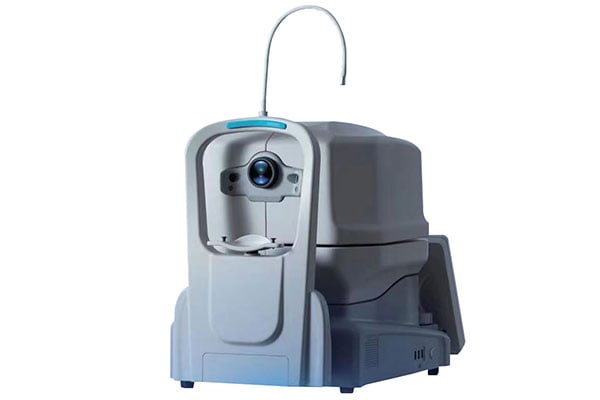
A functional glaucoma screening and management setup requires three core devices: a tonometer (IOP measurement), an auto perimeter (visual field testing), and a slit lamp with an imaging module (anterior segment and optic disc assessment). OCT adds a fourth layer for structural nerve fiber layer analysis in established or suspected cases.
The Core Equipment Stack
| Device | Role in Glaucoma Program | Minimum Spec Needed |
|---|---|---|
| Tonometer | IOP measurement (primary screening parameter) | NCT for screening; applanation for confirmation |
| Auto Perimeter | Visual field loss detection (functional assessment) | 22+ test programs, SITA-like algorithm |
| Slit Lamp | Optic disc examination, anterior segment | Standard desktop with imaging module |
| OCT | Retinal nerve fiber layer (RNFL) structural analysis | Spectral domain, ≥24,000 A-scans/sec |
Not every program needs all four from day one. A primary-care screening program may start with tonometer and perimeter only, referring suspicious cases to a specialist. A dedicated glaucoma clinic that manages patients long-term needs all four.
Starting Point: Tonometer + Perimeter
The combination of IOP above threshold AND corresponding visual field defect is the diagnostic basis for most glaucoma diagnoses. A screening program that measures only IOP will miss normal-tension glaucoma — a condition where irreversible optic nerve damage occurs at statistically normal IOP levels.
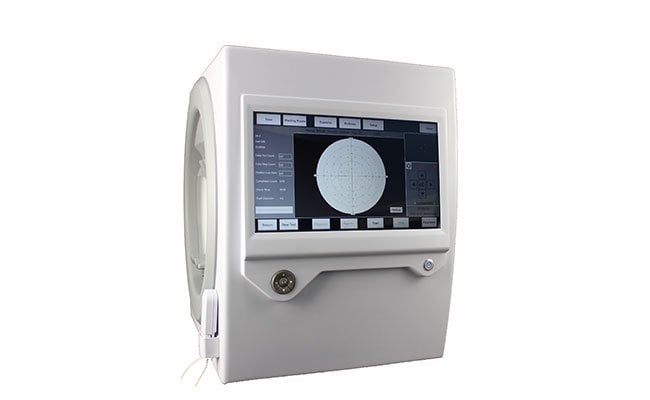
Adding the auto perimeter to the equipment mix closes this gap. Hongdee's AP-100 perimeter offers 22 test programs, SITA-like testing that reduces exam time by up to 50% compared to full-threshold methods, and voice guidance to assist patients through the procedure. Onboard storage handles over 10,000 tests with DICOM export for EMR integration.
How Does IOP Measurement Frequency Affect Patient Outcomes?
IOP is dynamic. It fluctuates throughout the day and responds to posture, exercise, hydration, and medication. A single IOP measurement at a clinic visit is a snapshot, not a trend.
For established glaucoma patients, IOP monitoring frequency affects treatment decisions. Patients with controlled IOP on medication need less frequent monitoring than those with unstable readings. High-volume clinic settings benefit from NCT technology — fully automatic bilateral measurement in under 30 seconds allows more frequent, efficient monitoring without increasing clinical staff workload.
Diurnal IOP Variation and Its Clinical Significance
IOP peaks are often missed in single-point measurements. Some patients show their highest IOP in the early morning; others peak in the afternoon. A single clinic visit may catch neither. This is why glaucoma management guidelines in Europe, North America, and Australia increasingly recommend monitoring across multiple time points — a process that requires fast, accurate, and repeatable IOP measurement.
The NCT's speed advantage is directly relevant here. A clinic that can check IOP in under 30 seconds per patient can feasibly offer diurnal curves as a standard diagnostic service. This is not possible with applanation tonometry, which requires setup, anesthetic, and operator attention for each measurement.
The Role of Patient Compliance in Monitoring Programs
A glaucoma program is only as good as patient adherence to follow-up appointments. Reducing the friction of each visit — shorter exam times, no anesthetic drops, no recovery period after dilation — directly improves attendance rates. The NCT's no-contact, no-anesthetic design makes it the right choice for monitoring programs where encouraging return visits is a program success metric.
What Role Does the Auto Perimeter Play Alongside Tonometry?
Tonometry answers "how high is the pressure?" The auto perimeter answers "has there been functional damage?" These are two different questions that together define glaucoma status.
The auto perimeter detects visual field loss — areas of the visual field where the patient cannot detect a light stimulus. In glaucoma, this loss is characteristic: arcuate defects, nasal steps, and temporal wedge defects correspond to optic nerve fiber bundle damage. A patient with elevated IOP and a normal visual field is a glaucoma suspect; a patient with elevated IOP and characteristic field loss has demonstrable glaucoma.
Understanding the AP-100 Test Programs
The Hongdee AP-100 offers 22 testing programs covering the majority of eye conditions related to visual field loss. This range matters because glaucoma is not the only condition causing visual field abnormalities. Neurological conditions, retinal diseases, and optic neuritis can all produce field defects. A broad test library allows the same instrument to serve multiple clinical needs within the same practice.
The built-in voice prompt system is a practical differentiator. Patients — particularly elderly patients with hearing loss or those who are anxious about what is expected of them — perform better when they have audio guidance throughout the test. Better patient performance means more reliable test results, which means fewer repeat tests wasted on poor quality data.
How Do You Scale a Screening Program for High-Volume Use?
A glaucoma screening program that works for 20 patients per day needs a different equipment configuration than one serving 200 patients per day.
High-volume glaucoma screening programs require equipment with fast measurement cycles, minimal operator intervention, and robust data management. The NCT's automatic bilateral measurement, the AP-100's SITA-like algorithm and DICOM export, and integrated EMR connectivity transform a manually intensive process into a scalable one capable of serving hundreds of patients daily.
Throughput Analysis by Equipment Configuration
| Configuration | Approximate Throughput (per 8-hour day) | Operator Skill Required |
|---|---|---|
| Rebound tonometer only | 80–100 patients | Low |
| NCT (automatic) | 150–200 patients | Very low |
| NCT + auto perimeter | 60–80 (full IOP + field) | Low-moderate |
| Full stack (NCT + perimeter + OCT) | 30–50 (comprehensive exam) | Moderate |
The right configuration depends on the program goal. Mass population screening — for example, a government diabetic eye disease program — needs maximum throughput with minimum operator intervention. A specialist glaucoma clinic that needs detailed characterization of each suspect needs the full stack, at the cost of lower daily patient volume.
Conclusion
A glaucoma screening program needs tonometry for IOP and perimetry for functional field assessment at minimum. The tonometer choice should match the clinical setting: NCT for volume, applanation for specialist confirmation, rebound for mobile or pediatric use. The auto perimeter's role is diagnostic confirmation, not replacement of tonometry. Scale the configuration to patient volume and program goals.