

What Are the Real Differences Between Rebound, Applanation, and Non-Contact Tonometers?
A new distributor asks you which tonometer to stock. You recommend the one you know best. That is not good enough. Each tonometer type serves a different clinical need, and getting it wrong means returns, lost accounts, and a damaged reputation.
Rebound, applanation, and non-contact tonometers all measure intraocular pressure (IOP) but use fundamentally different methods. Rebound uses a probe that briefly contacts the cornea; applanation uses a prism mounted on a slit lamp; non-contact uses an air puff. Each has distinct accuracy profiles, clinical use cases, and price points. Understanding these differences is the foundation of a credible tonometry product line.
The distributor who can explain these differences clearly to a clinic buyer is the one who gets the order.
How Does Each Tonometer Method Work?
The physics behind each measurement method determines its accuracy, user experience, and where it fits in a clinical workflow.
Rebound tonometry fires a small magnetized probe that briefly contacts the corneal surface and rebounds. The deceleration is measured and converted to IOP. Applanation tonometry flattens a defined area of cornea with a prism and measures the force required — the Goldmann standard. Non-contact tonometry uses a brief air puff to indent the cornea and calculates IOP from the corneal response time.
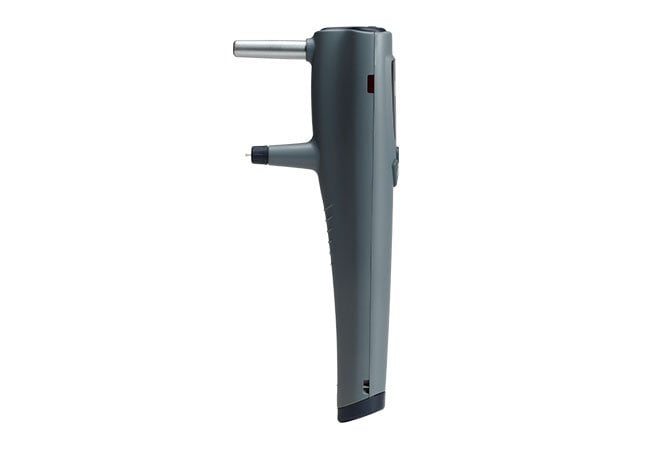
Rebound Tonometry (RT-100)
Rebound tonometry was developed specifically for situations where traditional tonometers are impractical. The probe is disposable, the device is handheld and battery-powered, and it requires no anesthetic eye drops. The patient barely feels the measurement.
Hongdee's RT-100 achieves ±0.5 mmHg accuracy with a measurement range of 3–70 mmHg. It works on human patients and is specifically validated for veterinary use — dogs, cats, and rabbits. For a clinic that sees both human and animal patients, or for any veterinary practice, the rebound tonometer is the only practical choice.
Goldmann Applanation Tonometry
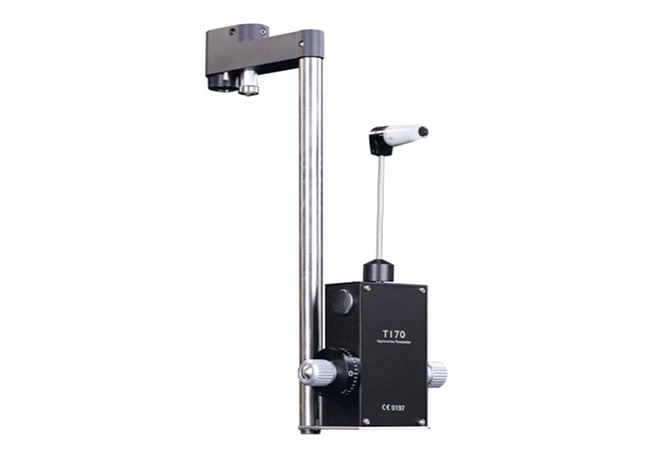
Goldmann applanation is the clinical gold standard against which all other methods are benchmarked. It is mounted on a slit lamp (T-Type for Haag-Streit, R-Type for Zeiss) and uses a fluorescein-stained tear film to measure the force required to flatten a defined corneal area.
Hongdee's digital applanation tonometer provides direct digital readout without conversion, with ±0.5 mmHg accuracy. Because it is slit-lamp mounted, it is used during routine anterior-segment examination — making it the natural choice for ophthalmologists who are already conducting a full slit lamp exam.
The limitation is infrastructure: it requires a slit lamp, an experienced operator, and anesthetic eye drops. It is not practical for outreach or high-throughput screening.
Non-Contact Tonometry (NCT)
The NCT uses an air puff to deform the cornea. No corneal contact, no anesthetic, no disposable probes. Hongdee's fully automatic NCT features 3D eye-tracking, a motorized chinrest, and one-button operation that completes bilateral measurement in under 30 seconds.
The IOP range is 0–60 mmHg with auto-switching between 0–30 mmHg and 0–60 mmHg ranges. DICOM 3.0 output integrates with EMR systems. For high-volume screening environments — hospital outpatient departments, optical chain stores, mass screening events — the NCT is the most efficient choice.
Which Tonometer Is Most Accurate for Glaucoma Management?
Accuracy is the most contested topic in tonometry. The answer is clinically nuanced and matters for distributors who sell into glaucoma-specialist markets.
Goldmann applanation tonometry remains the accepted clinical reference standard for IOP measurement in glaucoma management. Rebound tonometry correlates closely with Goldmann results in most studies and is increasingly used in specialist settings. Non-contact tonometry is adequate for screening but shows greater variability at higher IOP values, making it less suitable for precise glaucoma monitoring.
Understanding Measurement Variability
| Method | Accuracy (typical) | Influence of Corneal Thickness | Anesthetic Required | Glaucoma Management Suitability |
|---|---|---|---|---|
| Rebound (RT-100) | ±0.5 mmHg | Moderate influence | No | Good for monitoring |
| Applanation | ±0.5 mmHg (direct) | Known factor, correctable | Yes | Gold standard |
| Non-contact | ±1–2 mmHg at higher IOP | Significant influence | No | Screening only |
Central corneal thickness (CCT) influences all tonometry methods to varying degrees. Thicker corneas tend to produce higher readings; thinner corneas may underestimate IOP. Applanation tonometry's long clinical track record means its correlation with true IOP is well-characterized. Rebound tonometry's algorithm has been extensively validated against Goldmann results. NCT's accuracy degrades at higher IOP values — the exact range most critical in glaucoma monitoring.
For a glaucoma specialist practice, the applanation tonometer is non-negotiable as the primary measurement tool. For a general ophthalmology practice that needs both glaucoma monitoring capability and screening efficiency, a combination of applanation and NCT makes sense.
Which Tonometer Works Best for Pediatric and Veterinary Patients?
Pediatric and veterinary patients cannot follow standard instructions. This fundamentally changes which tonometer is appropriate.
Rebound tonometry is the preferred method for pediatric and veterinary IOP measurement. It requires no anesthetic, no patient cooperation beyond brief stillness, and works on small eyes including those of cats, dogs, and rabbits. Non-contact tonometry can be used on cooperative older children but is impractical for young children and impossible for most animals.
Pediatric Considerations
Children under five are unlikely to maintain position for applanation tonometry. The NCT's air puff can be frightening for young children, leading to reflex blinks that prevent measurement. The rebound tonometer's brief, gentle probe contact — combined with its silent operation and handheld form — allows the clinician to approach measurement opportunistically during a moment of cooperation.
For pediatric glaucoma practices, which may see patients as young as a few weeks old, the rebound tonometer is often the only practical tool until the child is old enough for sedated examination under a slit lamp.
Veterinary Considerations
The RT-100's explicit veterinary validation is a meaningful differentiator in markets where eye disease in animals is a growing concern. Progressive retinal atrophy, glaucoma in dogs, and hypertensive retinopathy in cats are increasingly diagnosed and managed conditions. A veterinarian who wants to monitor IOP over time needs a tonometer that works without sedation for routine checks.
How Do You Choose the Right Tonometer by Clinic Volume and Budget?
Clinical accuracy matters, but so does practical economics. A buying recommendation needs to account for throughput requirements, budget constraints, and the distributor's margin structure.
High-volume screening environments should prioritize the NCT for throughput. Specialist ophthalmology practices need applanation as the clinical standard. Pediatric, veterinary, and mobile practices need the rebound tonometer. Budget-conscious buyers in all segments benefit from knowing that rebound tonometers offer the lowest cost per exam given no ongoing consumable requirement beyond disposable probes.
Recommended Configuration by Practice Type
| Practice Type | Primary Recommendation | Secondary / Optional |
|---|---|---|
| High-volume hospital outpatient | NCT (automatic, bilateral, fast) | Applanation for glaucoma dept |
| Specialist glaucoma clinic | Applanation (Goldmann standard) | Rebound for children/difficult patients |
| General ophthalmology practice | NCT + applanation combination | Rebound for difficult patients |
| Pediatric ophthalmology | Rebound (RT-100) | — |
| Veterinary practice | Rebound (RT-100) | — |
| Mobile / outreach screening | Rebound (RT-100) | NCT if power available |
| New clinic, limited budget | Rebound (lowest upfront cost) | Upgrade to NCT as volume grows |
Hongdee offers all three tonometer types within a single product line with a consistent warranty and after-sales framework. For distributors building a complete ophthalmology product portfolio, this means a single supplier relationship covers the full tonometry segment — simplifying logistics, training, and customer support.
Conclusion
Rebound, applanation, and non-contact tonometers each serve distinct clinical roles. Applanation is the gold standard for glaucoma diagnosis; rebound is the best choice for pediatric, veterinary, and mobile use; NCT maximizes throughput in high-volume screening. No single type replaces the others. A well-stocked distributor carries all three and knows when to recommend each.